The Sewer Project Riomar Barely Noticed, and Why That Was the Point
September 10, 2026
September 10, 2026
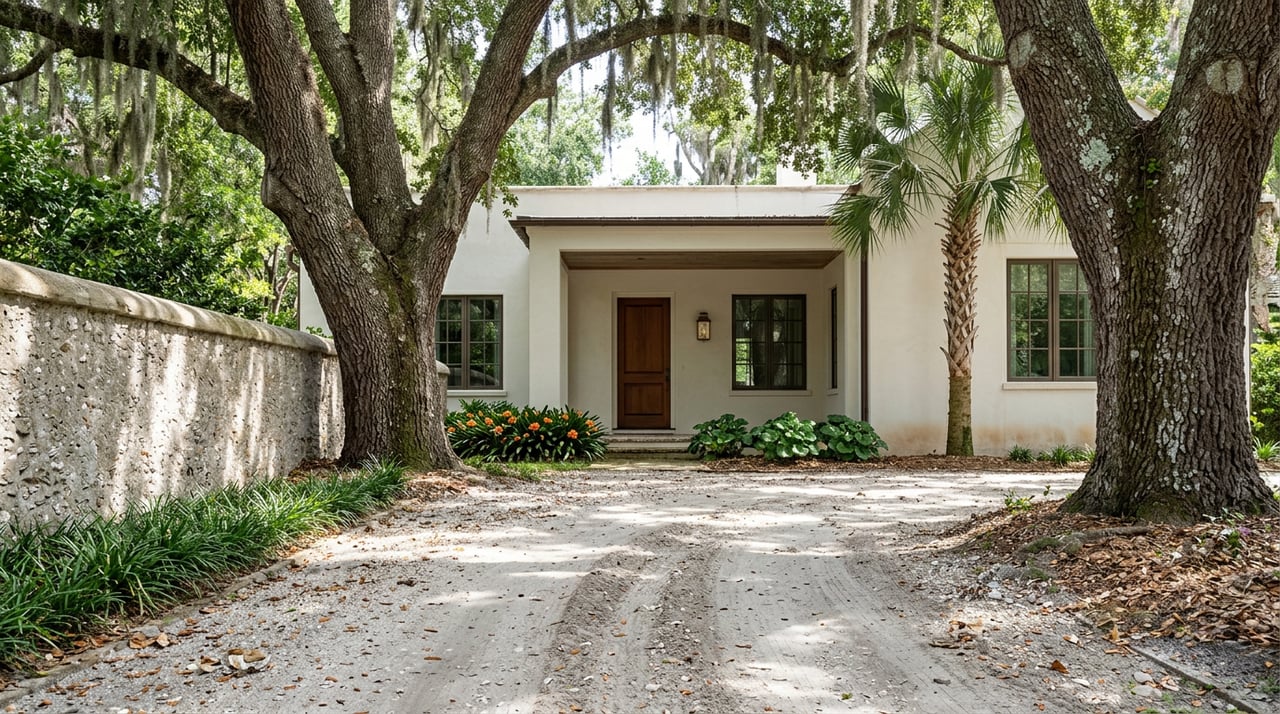
Walk the sandy lane along Sandfly some mornings this year and you might spot a small orange flag stuck in the shoulder, a two-person crew working for an afternoon, then nothing. No trench cut across the street. No root system torn up under the oak canopy that has shaded these lanes since the 1920s. A week later you would not know anyone had been there at all.
Now head north to the intersection of A1A and Beachcomber Lane in Indian River Shores, where an empty lot has spent months stacked with pipe sections, raw dirt, and heavy equipment staging for a sewer and road replacement project loud enough that passing motorists keep stopping to ask what is being built. It is not a new building. It is the same underlying problem Riomar has been quietly solving for over a decade: aging septic tanks that leak into the Indian River Lagoon, now under a state deadline to disappear.
One mandate, two completely different experiences of construction. The difference is not luck. It is a deliberate engineering choice the City of Vero Beach made specifically because of what runs under Riomar's sandy streets.
The state law behind all of this passed in 2023, giving Florida municipalities until July 1, 2030 to connect septic-tank homes to municipal sewer. Vero Beach set its own internal deadline even tighter, requiring STEP hookup by June 1, 2028, or within one year of a property's sale or transfer, whichever comes first, according to the city's own municipal code.
What makes Riomar's version of this project nearly invisible is a system called STEP, short for Septic Tank Effluent Pump. Instead of digging a trench for a conventional gravity sewer main, contractors bore small 2-inch polyethylene lines underground from the existing sewer network into a neighborhood, then run narrower lateral pipes into individual lots using directional boring rather than open trenching. The septic tank stays in place. A small pump pushes the liquid waste, called effluent, into the new line instead of letting it sit in the ground.
City Water and Sewer Director Rob Bolton has been candid about why Vero Beach chose this method for its oldest island neighborhoods rather than the traditional approach used elsewhere. The small-bore pipes do not require tearing up streets or damaging yards, which matters directly in a neighborhood where the root systems of century-old live oaks run under nearly every lane. It is also roughly half the cost of a conventional gravity sewer installation, according to reporting on the project.
That single decision is the quiet mechanism behind everything a Riomar resident has or has not noticed on their street.
| STEP system (used in Riomar) | Conventional gravity sewer (used elsewhere) | |
|---|---|---|
| Installation method | Directional boring, no open trenching | Open trench excavation |
| Street disruption | Minimal, spot work only | Full lane closures common |
| Impact on mature tree roots | Designed to avoid root systems | High risk of root damage |
| Relative cost per connection | Less than half of gravity sewer cost | Higher, per city reporting |
The Shores project a few miles north illustrates what the alternative looks like when a smaller municipality bundles sewer work with full road and curb replacement instead. That work is being combined with repaving and stormwater infrastructure specifically because doing both at once saves homeowners from paying for the same road twice, but it comes with a real financial edge: affected property owners there are facing conversion costs that could run as high as $40,000 each, and roughly 70 residents have petitioned the town for financial relief. Vero Beach's STEP approach in Riomar, Bethel Creek, the Live Oak section of Central Beach, and South Beach was engineered specifically to avoid that scale of disruption and expense.
As of the midpoint of 2025, Vero Beach had passed the halfway mark on its citywide STEP conversion, with more than half of the homes in those four legacy septic neighborhoods, Riomar included, already hooked up at that point. The remaining homes are slated to connect ahead of the city's 2028 deadline. As the city pushes STEP further south to island subdivisions outside its own limits, Bolton has said the neighborhood-by-neighborhood approach with smaller contractors, rather than one large firm, is expected to cut costs roughly in half compared to a single big contract, the same economics that made the method work for Riomar.
Put plainly: most of the work under Riomar's oaks has already happened, and most of it happened without the neighborhood noticing much beyond an occasional flag and a brief visit from a crew. If your home is one of the remaining connections, city documents show individual special assessment liens are still being issued as recently as this spring, so it is worth checking your utility account status if you are unsure where your property stands.
None of this matters much unless you understand what those roots are actually holding up. Riomar traces back to 1919, when three doctors from Cleveland formed the East View Development Company and purchased a stretch of barrier island that was, at the time, a genuine jungle of vines, palms, and live oaks draped in Spanish moss. They laid out a nine-hole golf course and a clubhouse, and the sandy lanes that wind through the neighborhood today were never fully paved, preserving much of that original character. The canopy those doctors found still arches completely over several streets.
That canopy is also why so much of daily life in Riomar happens without a car. It is a short golf-cart ride from most homes to Sexton Plaza, where residents stop for coffee at Giving Tree Coffee or Tribe Coffee, or pick up something from Carmine and Lucia's Fine Oil and Balsamics on the way home. Dinner options within the same easy radius include Ocean Grill, the oceanfront seafood landmark that has been serving Vero Beach for decades, the more casual Waldo's, and Polo Grill for something dressier. Riverside Park, Riverside Theatre, and the Vero Beach Museum of Art all sit within that same walkable, bikeable, golf-cartable stretch, alongside the City Marina and Vero Beach Dog Park.
The neighborhood also holds onto a smaller custom that says something about how residents actually live here: flipping up a mailbox flag as a signal to neighbors that they are welcome to stop in for a drink. It is the kind of detail that only survives in a place where people still know their neighbors well enough to read a mailbox flag as an invitation, and it is hard to imagine that custom surviving years of trenched streets and torn-up yards.
If you have lived in Riomar through the past few years, you have already been part of a sewer conversion most of your neighbors elsewhere on the Treasure Coast are still fighting through with heavy equipment and steep assessments. The city's decision to spend more engineering effort on a method that spares tree roots was not an accident of budget. It was a recognition that the oaks, the sand, and the walkability are the actual asset here, and that tearing up the streets to solve an environmental problem would have solved one problem by creating another.
The work is not entirely finished. If your address has not yet been connected, expect the same low-disruption pattern that has already played out on most of your neighbors' streets: a short visit from a small crew, a bored line run under your yard rather than through it, and a deadline that gives you until June 2028, or the sale of your home, whichever comes first.
For a neighborhood that has spent more than a century protecting the same canopy of oaks, that quiet approach was never really optional. It was the only version of this project that fit.
If you are curious about how Riomar's history, its live oaks, and its walkable rhythm compare to other pockets of Vero Beach's barrier island, our Riomar neighborhood guide goes deeper into the streets, the club, and the homes that make this stretch of the island what it is. And if you are ever curious what your own Riomar property might be worth in today's market, Vero Premier Properties can put together a straightforward valuation whenever you are ready, no obligation attached.
Lead Real Estate Agent
Buying a home is a very emotional experience, especially for those who have not done it very often. My experience in sales can help guide buyers with an analytical approach.
Find Your Dream Home
Get assistance in determining current property value, crafting a competitive offer, writing and negotiating a contract, and much more. Contact us today.