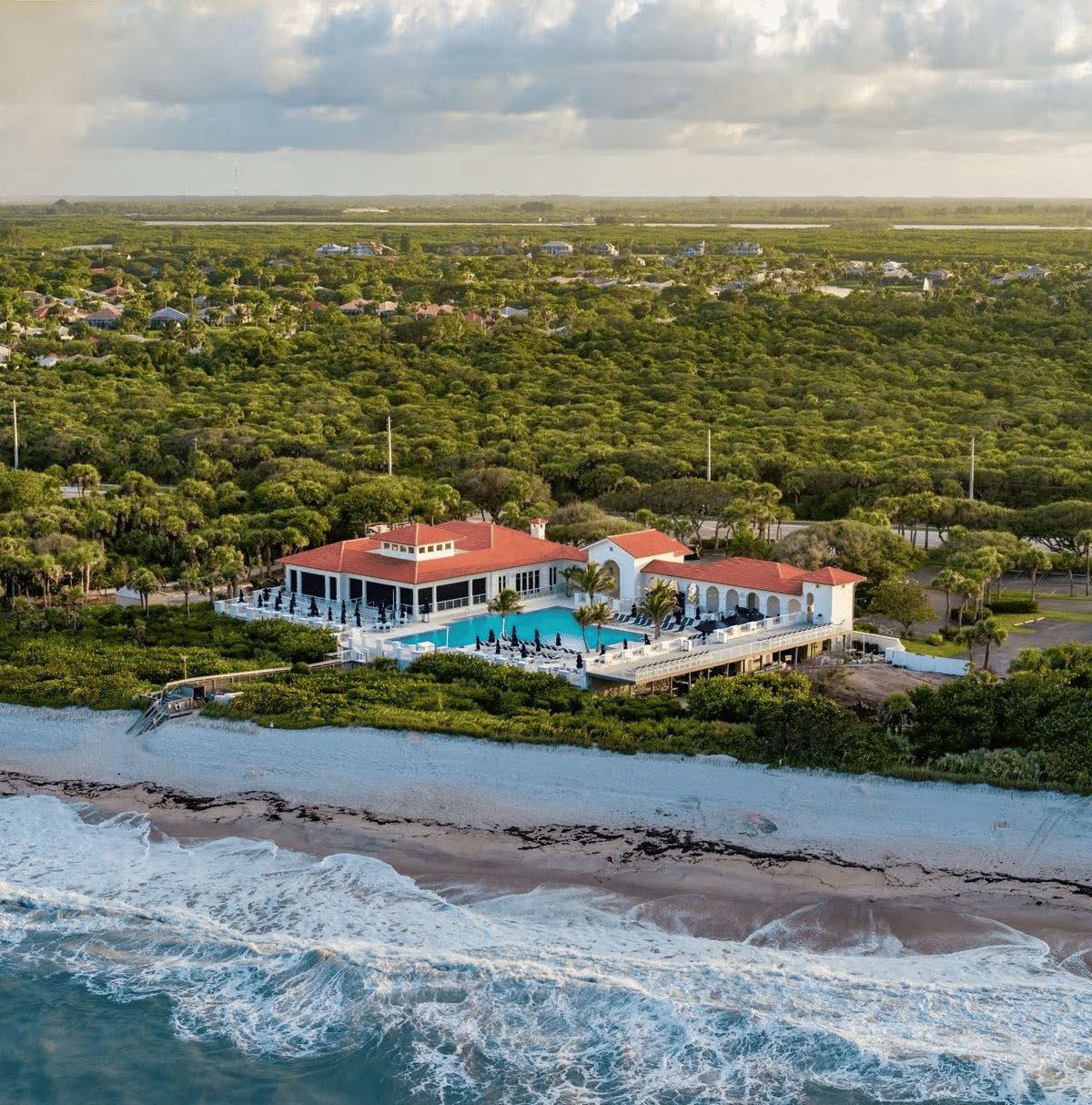
The conversation almost never begins with Vero Beach. It begins with a tax return. Specifically, the realization — visceral, unavoidable, arithmetically irrefutable — that a household earning three million dollars a year is writing a check to New York State and New York City that could, with a single legal change of address, be redirected entirely toward building their family's wealth. That is the number that starts the phone calls. And increasingly, those calls end here.
Florida has no state income tax. No city income tax. No inheritance tax. No estate tax at the state level. For the high-net-worth household that has spent a career in New York, New Jersey, Connecticut, or Boston, those four sentences represent a financial restructuring of breathtaking magnitude — and Vero Beach has quietly become the address where the country's most financially sophisticated buyers are choosing to make that restructuring permanent.
This is the full picture. Not a brochure. A guide — written for the household that has already run the numbers with their CPA and now needs the nuance, the sequencing, and the story of how others like them have navigated it.
New York's True Cost: The Spreadsheet Your CPA Already Ran
New York State imposes an income tax of 10.9 percent at the top marginal rate. New York City adds up to 3.9 percent on top of that. Combined, a New York City resident earning million annually faces a state and city income tax burden approaching 40,000 — every single year, in perpetuity, for the privilege of remaining domiciled in a state that does not distinguish between a struggling small business owner and a household with a nine-figure net worth.
Florida imposes zero state income tax. Zero city income tax. The combined saving at million in annual income is not a rounding error — it is, conservatively, 50,000 to 50,000 per year, depending on the composition of income, applicable deductions, and residency structure. Over a decade, that figure compounds into a number that changes the trajectory of a family's wealth.
| Annual Income | NY State + NYC Tax (Est.) | Florida Tax | Annual Savings | 10-Year Savings |
|---|---|---|---|---|
| 00,000 | 4,500 | /bin/sh | 4,500 | 45,000 |
| ,000,000 | 48,000 | /bin/sh | 48,000 | ,480,000 |
| ,000,000 | 96,000 | /bin/sh | 96,000 | ,960,000 |
| ,000,000 | 44,000 | /bin/sh | 44,000 | ,440,000 |
| ,000,000 | 38,000 | /bin/sh | 38,000 | ,380,000 |
Estimates based on combined NY State (10.9%) and NYC (3.9%) top marginal rates applied to approximate taxable income. Actual savings depend on income composition, deductions, and filing status. Not tax advice — consult your CPA.
"The SALT cap changed the calculus permanently. What was once a planning consideration became, after 2017, an urgent financial imperative. The question is no longer whether to consider the move — it is how to execute it correctly."
— Ben Bryk, Florida East Coast Luxury Homes · Coldwell Banker Global LuxuryThe 0,000 Cap That Rewrote the Equation for Every High-Income Household
Before the Tax Cuts and Jobs Act of 2017, high-income households in New York could deduct their full state and local tax burden — often 0,000 to 00,000 or more — from their federal taxable income. The SALT deduction was, in effect, a partial federal subsidy for remaining in high-tax states. That subsidy was capped at 0,000 in 2017 — and while Washington continues to debate its future, the effect on the wealth calculus of remaining in New York has been permanent.
The SALT cap means that for a household paying 00,000 in New York state and city taxes, roughly 90,000 of that burden is now non-deductible at the federal level. In practical terms, every dollar of New York tax above 0,000 now costs you a full dollar — with no federal offset. The ROI on establishing Florida primary residency became, almost overnight, immediately visible on any competent CPA's spreadsheet.
The SALT Cap Is Not Going Away — Plan Accordingly
While legislative proposals to raise or eliminate the SALT cap have circulated in Congress, no permanent change has been enacted. High-net-worth households should plan their domicile strategy based on current law — which provides zero relief above 0,000 — rather than anticipated legislative outcomes that may never materialize. The financial case for Florida domicile remains overwhelming regardless of SALT cap policy.
The Homestead Exemption: Florida's Long-Game Advantage for Luxury Buyers
Most Northeast buyers arrive in Florida focused entirely on the income tax saving. What they discover — often with considerable delight — is that Florida's homestead system provides a second, compounding layer of financial protection that becomes more valuable with every passing year.
0,000 Off Your Assessed Value — Immediately
Florida's homestead exemption reduces the assessed value of a primary residence by up to 0,000 for property tax purposes. On a million home, the direct annual saving may be modest — but it triggers eligibility for the Save Our Homes cap, which is where the real long-term value lies.
Your Property Tax Assessment Cannot Rise More Than 3% Per Year
Once you establish homestead, Florida caps annual increases in your assessed value at 3% or the Consumer Price Index — whichever is lower. In a market like Vero Beach, where luxury property values have appreciated meaningfully, this cap protects long-term owners from runaway property tax bills even as their home's market value grows. A buyer who purchases in 2025 and holds for a decade could see their assessed value significantly below market value — a structural tax advantage that accumulates year after year.
Take Your Tax Savings With You When You Upgrade
Florida's portability provision allows homestead owners to transfer their accrued Save Our Homes benefit — up to 00,000 — to a new Florida primary residence. This means that if you establish homestead today and build a substantial cap benefit over time, you do not lose it when you move to a larger home or a different Florida market. It travels with you — a portable, transferable wealth asset that most buyers do not initially understand and quickly come to deeply value.
The Legal Move: Establishing Florida Domicile Without Triggering a New York Audit
New York State is, by national reputation, the most aggressive auditor of taxpayers who claim to have changed their domicile to another state. The New York Department of Taxation and Finance runs a dedicated residency audit unit whose sole purpose is to challenge high-income taxpayers who have relocated — or claim to have relocated — to lower-tax jurisdictions. The stakes are not trivial: a failed audit can result in years of back taxes, interest, and penalties running well into the millions.
The critical distinction is between statutory residency — spending more than 183 days in New York while maintaining a permanent place of abode — and domicile — the state that is your true, fixed, permanent home. New York auditors examine both. Passing the 183-day test alone is insufficient. You must also be able to demonstrate, through documentation, habit, and the totality of your life circumstances, that Florida — not New York — is your domicile.
- Florida Driver's License & Voter Registration — Obtain both immediately upon establishing Florida residency. These are the two most important signals to New York auditors of a genuine domicile shift.
- Declaration of Domicile — File a Declaration of Domicile with the Indian River County Clerk of Court. This is a formal legal document that establishes your intent to make Florida your permanent home.
- Update Estate & Legal Documents — Revise your will, trust documents, power of attorney, and healthcare directives to reflect your Florida address and Florida law. Retain a Florida estate attorney for this step.
- Primary Banking Relationship — Transfer your primary checking, savings, and investment accounts to institutions with Florida addresses or branches. Credit card statements, bank records, and wire transfers are standard audit targets.
- 183-Day Documentation — Maintain a contemporaneous log of days spent in each state. Credit card records, phone records, EZ Pass data, and boarding passes are all subject to subpoena in a domicile audit. Document Florida days proactively.
- Close Connections Test — Beyond day-counting, New York applies a "closest connections" analysis. Where are your closest friends and family? Where do you worship? Where is your primary physician? Where is your most valuable property? Each answer should point to Florida.
- Resign NY Club Memberships or Reclassify — Maintaining active membership at a New York club as your primary affiliation is a domicile audit red flag. Shift primary club affiliation to Florida.
Establish Domicile Before the Liquidity Event
If you anticipate a significant liquidity event — a business sale, equity vesting, real estate gain, partnership distribution, or inheritance — the domicile switch must be legally complete before the income is recognized. New York will attempt to tax income earned during your residency period. Completing the move 12 to 18 months before the event, with clean documentation, is the gold standard. Our Financial Concierge Desk coordinates directly with your estate attorney and CPA to ensure the timing is airtight.
Florida's Estate Advantage — What Your Estate Attorney Wants You to Know
Florida imposes no state estate tax and no state inheritance tax. New York imposes an estate tax with a top rate of 16 percent on taxable estates above the New York exclusion amount — which, unlike the federal exclusion, does not unify with the federal threshold, creating what estate planners call the "cliff effect" for estates that modestly exceed the New York threshold.
For a household with a net worth above 0 million, the estate tax differential between New York and Florida domicile can represent millions of dollars in generational wealth transferred to heirs rather than to state government. This is not a peripheral consideration — for many high-net-worth families, the estate planning advantage of Florida domicile rivals or exceeds the annual income tax saving.
Florida also offers exceptional asset protection through its homestead law, which in many circumstances shields a primary residence from creditor claims — a meaningful structural protection for business owners, professionals, and executives with personal liability exposure.
The 62.7% Market: Why the Most Financially Astute Buyers in America Are Choosing Vero Beach
The data point is arresting. Approximately 62.7 percent of luxury home transactions in Vero Beach close as all-cash purchases — making it one of the highest cash-purchase rate markets in the United States for luxury real estate. That number is not a market anomaly. It is a precise portrait of the buyer arriving here: financially liquid, analytically rigorous, and drawn from the most affluent zip codes in New York, New Jersey, Connecticut, and Boston.
These are not buyers who discovered Vero Beach through a travel magazine. These are households whose CPAs identified the tax opportunity, whose estate attorneys structured the domicile transition, and whose due diligence led them to a barrier island on Florida's Treasure Coast that offers something increasingly rare in American luxury real estate: genuine value relative to the lifestyle it delivers.
Vero Beach trades at a compelling discount to Palm Beach on a per-square-foot basis — while offering barrier island privacy, deepwater Intracoastal access, a world-class private club ecosystem including the Quail Valley River Club and the Vero Beach Country Club, and a quality of life that the Northeast's most discerning buyers have found, to their considerable surprise, equals or exceeds what they left behind. Without the theater of it.
"Vero Beach is what Palm Beach was forty years ago — before the world fully arrived. The buyers we are seeing today are the same profile that established Palm Beach as the defining address of American luxury. They are early, and they know it."
— Vance Brinkerhoff, Florida East Coast Luxury Homes · Coldwell Banker Global LuxuryThe wealth migration from the Northeast is not a trend. It is a structural demographic and fiscal shift that is reshaping Florida's luxury market in ways that will compound for decades. The buyers arriving in Vero Beach in 2025 are establishing homestead, building their Save Our Homes cap benefit, and positioning themselves to capture the appreciation of a market that the national press has not yet fully written about — but will.