Alan Greenspan died on Monday at his home in Washington, at the age of one hundred. For nearly two decades he held an office whose every syllable was parsed, whose every pause moved markets, and whose decisions shaped the financial lives of Americans who never knew his name. He was, in the language of the markets that revered him, the Maestro — and today, this country is diminished by his absence.
His wife of twenty-nine years, the NBC News correspondent Andrea Mitchell, confirmed that he had died from complications of Parkinson's disease. He was, she said, a giant of a man who helped shape the American economy for decades under presidents of both parties, and who was always honest in acknowledging his mistakes. It is a fitting epitaph for an economist who understood, perhaps better than any of his contemporaries, that policy is judged not in the moment but across the long arc of the cycle. And across that arc, Alan Greenspan delivered for the American people in a manner few who have held public office can claim.
We note his passing here not because economics and real estate share a ledger — though they do — but because those of us who have spent careers in the business of helping American families build wealth through property owe Alan Greenspan a particular debt of gratitude. The era he stewarded was, for the affluent American household, a period of extraordinary and unprecedented wealth formation. The equity that now moves quietly from the Northeast to the Florida coast was, in no small part, built in the years he governed. That is not a small thing. That is a life's work — shared with a nation.
An Eighteen-Year Tenure Across Four Presidencies
Greenspan was appointed chairman of the Federal Reserve by President Ronald Reagan in August of 1987, succeeding Paul Volcker. He would serve until January of 2006, across the administrations of Reagan, George H.W. Bush, Bill Clinton, and George W. Bush — the second-longest tenure in the institution's history, surpassed only by William McChesney Martin. Few public servants of any kind have exercised so durable an influence over so consequential a domain.
His command was tested almost immediately. Two months into his chairmanship, on the October day that came to be known as Black Monday, the Dow Jones Industrial Average fell more than twenty-two percent — the largest single-day percentage decline in its history. Greenspan moved decisively to keep the markets liquid, and in doing so established a pattern that markets would come to expect of the Fed in every subsequent crisis. The instinct repeated through the financial turbulence of the late nineteen-nineties, through the dot-com unwinding, and through the unsteady weeks that followed the eleventh of September, two thousand one.
He presided over the longest unbroken economic expansion this country has ever recorded — a decade of growth that ran from March of nineteen-ninety-one to March of two thousand one, a full one hundred and twenty months without recession. Consider what that means in human terms: an entire decade during which American businesses expanded, wages rose, homeownership climbed, and a generation of families entered the middle class and, in many cases, moved beyond it. No Fed chairman before him had ever delivered that. No one since has come close.
His willingness to let the economy run — to resist the pressure to raise rates against inflation fears that never materialized — was, in retrospect, an act of considerable nerve and profound wisdom. The economists around him counseled caution. The models predicted overheating. Greenspan looked at the data differently. He recognized, before the mainstream had caught up, that the productivity surge of the mid-nineteen-nineties was structural — that technology was changing the underlying arithmetic of the economy in ways the old frameworks could not yet measure. He was right. The expansion continued. American prosperity deepened. And an entire generation of households built the financial foundation they are living on today.
A Personal Note — From Ben & Vance
There are figures in public life whom one admires from a distance — whose work you study, whose judgment you respect, whose decisions shaped the arc of your own career even if you never shared a room. For both of us at Vero Premier Properties, Alan Greenspan was that figure.
We have spent our careers helping families navigate one of the most consequential financial decisions of their lives — the decision of where to put down roots and what to build on them. That work takes place against a macroeconomic backdrop that someone had to construct. For the decades in which most of our clients built their wealth, Alan Greenspan was the man who constructed it. The low rates that made homes accessible. The stable prices that made long-term planning possible. The steady hand that kept the markets functioning through Black Monday, through the Asia crisis, through the aftermath of September eleventh. He was there — every time. And the country was better for it.
We extend our deepest respect to his family, and to Andrea Mitchell, who cared for him and loved him across twenty-nine years of shared life. The nation has lost a great man. We are grateful for the era he gave us.
— Ben & Vance, Vero Premier Properties
A Legacy That Includes Its Own Critics
No honest account of Greenspan's career omits its more difficult chapters. The same low-rate environment and the same confidence in deregulated markets that defined his prosperous middle years are widely understood to have contributed to the conditions of the housing bubble and the subprime crisis that broke in 2007. He himself acknowledged, in testimony after the fact, that he had found a flaw in his model of how the world worked. That candor — the readiness of a man at the summit of his field to concede error — is among the qualities for which he was admired, and it is the quality his wife chose to name first.
It is worth observing, with the clarity that distance affords, that the crisis was a crisis of leverage. It was a story of credit extended too freely against assets purchased too speculatively. The luxury tier of the housing market — the segment in which substantial equity changes hands rather than substantial debt — has always behaved differently, and behaves differently still. That distinction is not incidental to the market we know best. It is central to it.
What the Era He Built Means for the Buyers of Today
A generation of American homeowners accumulated real estate wealth across the decades Greenspan shaped. For the affluent households of the Northeast — in Fairfield County, in Westchester, on the North Shore of Chicago — that accumulation has reached a point of decision. The question is no longer whether the equity exists. It is where that equity will ultimately reside.
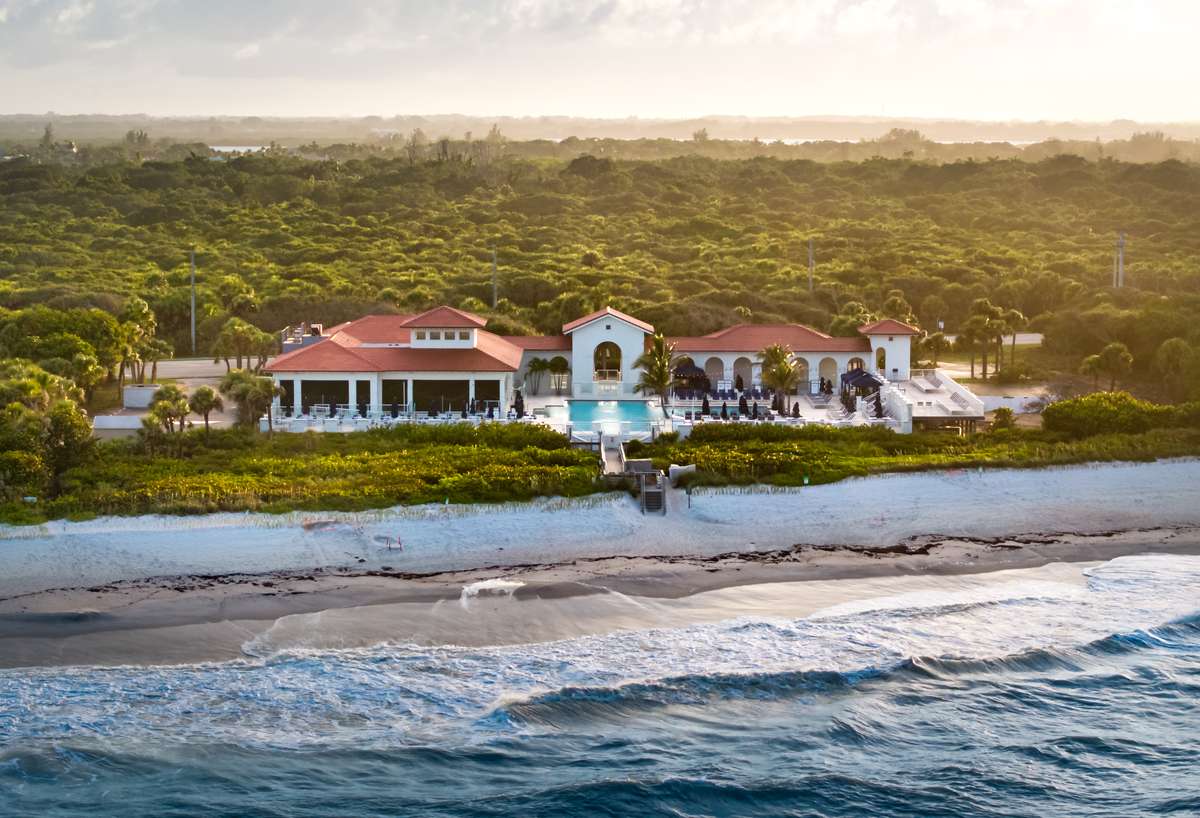
Increasingly, the answer is the Florida coast. And here the legacy of an era of cheap credit gives way to a market that has never depended on it. On the Vero Beach barrier island, financing is frequently beside the point. Roughly sixty-three percent of transactions close all-cash — a figure that insulates the luxury tier almost entirely from the rate sensitivity that governs more leveraged markets. The buyer relocating from the Northeast is not borrowing against a future. He is deploying the proceeds of decades already lived.
There is a further dimension to the calculus, and it is a question of where wealth is kept rather than merely where it is made. Florida levies no state income tax and no estate tax. For the household that has spent a career in a high-tax jurisdiction, the difference compounds — quietly, annually, and in a manner that the most disciplined portfolio manager would recognize as material. Greenspan, who built his early reputation analyzing the cold arithmetic of markets, would have understood the logic precisely.
The window for one such advantage is, at the moment, a matter of public record. A measure expanding Florida's homestead protections, designated HJR 1-F, passed the state legislature on the second of June and will appear before voters on the November ballot, where it requires sixty percent approval to take effect. Should it pass, it carries a residency deadline of the thirty-first of December. We note it not as urgency for its own sake, but because the timing is real and the decision is, for many, already underway. Its provisions are contingent upon voter approval and should be regarded as such.
Alan Greenspan understood that wealth is not a moment but a sequence — that what is earned in one season is preserved, or squandered, in the next. The fortunes built across the long expansion he governed are now making their next decision. For a growing number of discerning households, that decision leads to the Florida coast. It is the final chapter of a story whose opening was written, in no small part, by the man we honor today.
We have lost a great American. His legacy — measured not in the words of economists but in the financial security of millions of ordinary families — will endure far longer than the headlines that mark his passing. Rest well, Mr. Chairman.