The Audit Trail: Why High-Net-Worth New Yorkers Get Targeted After Moving to Florida
Ben Bryk May 26, 2026
Ben Bryk May 26, 2026
New York State's residency audit program is not a random process and it is not a minor inconvenience. It is a systematic, data-driven enforcement operation specifically engineered for high-income departures — and understanding exactly how it identifies, selects, and pursues its targets is the first step toward ensuring that your move to Vero Beach is never one of them.
There is a file. It exists before you leave. By the time a high-earning New York household files its first return as a Florida resident, New York State's Department of Taxation and Finance has already identified it as a departure of interest — cross-referenced its income against prior years, flagged the filing address change, and initiated a preliminary data review that may or may not escalate into a formal audit proceeding. The process is not reactionary. It is proactive, systematic, and highly targeted at exactly the profile of household that is most likely to be considering a move to Vero Beach.
Understanding how the targeting mechanism works — what triggers formal scrutiny, what data sources auditors use, what the questionnaire actually asks, and what the realistic timeline of a contested audit looks like — is not a paranoid exercise. It is essential planning intelligence for any high-net-worth household making this transition. The buyers who fare best in audit are not necessarily the ones who did everything perfectly. They are the ones who understood the process and made their move accordingly.
New York's residency audit program operates through a combination of automated data-matching and human review. The state receives information returns from employers, financial institutions, and federal agencies — the same underlying data that flows to the IRS — and uses it to identify high-income filers whose tax returns reflect a change in residency status. The higher the income, the more likely the review.
The income threshold that reliably triggers enhanced scrutiny is not publicly stated, but practitioners experienced in this area broadly observe that households with prior-year New York income in excess of one million dollars face near-certain review upon filing as part-year or non-residents. For households at the ten-million-dollar level and above, the review is effectively automatic. This is not an accident. It reflects the arithmetic of New York State's revenue interest in retaining its highest earners.
The primary selector. Households with prior New York income above $1 million face near-certain review upon filing as non-residents. Above $10 million, review is effectively automatic. The state's revenue interest is direct: a single successful audit of a $5 million earner can recover years of six-figure annual tax liability plus interest and penalties.
The departure signal. When a previously high-income New York filer appears on a part-year or Florida return, the income change is automatically flagged. The state then evaluates whether the departure is genuine or whether New York-source income has been misallocated to a lower-tax jurisdiction.
The most common flag. Property records are public. A taxpayer who claims Florida domicile while maintaining a New York cooperative, condominium, or residence on property records immediately raises the statutory residency question. Auditors request utility records, access logs, and credit card statements to reconstruct actual occupancy.
The operational anchor. A claimed Florida domicile paired with a New York business address, New York professional licenses, New York-based employees, or New York client relationships invites scrutiny of whether the taxpayer's economic life genuinely centered in Florida or whether Florida was a residential address of convenience.
The most scrutinized pattern. A taxpayer who departs New York in the same year as — or immediately before — a significant liquidity event: a business sale, an IPO, a large capital gain, or a substantial bonus. The state will examine whether the departure was genuine or whether it was timed to avoid New York taxation on a specific, anticipated income event.
The relationship network. Ongoing New York club memberships, charitable board positions, professional association memberships, and documented social engagements in New York — appearing in calendars, credit card records, or publicly accessible sources — all contribute to a picture of continued New York connection that an auditor will use to challenge domicile claims.

The New York residency questionnaire is the central instrument of the audit process. It is a multi-page document that arrives, typically, within one to three years of a claimed departure. Its questions are not casual inquiries. They are a structured forensic examination designed by tax attorneys who understand exactly what information is needed to reconstruct domicile — and by auditors who know where taxpayers are most likely to have left themselves exposed.
Representative categories from New York State's standard residency examination — each designed to establish the location of the taxpayer's true center of life.
The questionnaire is not answered in isolation. Auditors independently develop evidence through the data sources available to them — and the breadth of those sources is significantly broader than most taxpayers expect.

A residency audit initiated by New York State can take between one and four years to resolve, depending on the complexity of the taxpayer's financial life and the strength of the domicile evidence on both sides. The process typically begins with the questionnaire, proceeds to an information and document exchange, may involve in-person interviews, and — in contested cases — can escalate to the New York State Division of Tax Appeals and, ultimately, to the courts.
The taxpayer bears the burden of proof in demonstrating that a domicile change was genuine. This means that the absence of documented Florida life — established memberships, transferred possessions, verified day counts, a primary home that is clearly superior to any retained New York property — works against the taxpayer. It is not sufficient to show that the taxpayer spent fewer than 183 days in New York. It is necessary to show that Florida was genuinely home.
New York's standard audit window is three years from the date a return is filed. However, if the state determines that a taxpayer substantially understated income — a determination that can arise from a successful residency challenge that pulls New York-source income back into the tax base — the statute extends to six years. If fraud is alleged, there is no statute of limitations at all. For high-net-worth households, the combination of extended look-back periods and significant annual income means that a single successful audit can cover multiple tax years simultaneously, compounding the exposure considerably.
62.7% of Vero Beach luxury transactions close in cash — the highest concentration in the United States. The buyers arriving from the northeastern corridor are not maintaining New York as their operational center. They are relocating with conviction — establishing primary residences, joining private clubs, transferring personal possessions, and building the documented Florida life that is simultaneously the most defensible audit position and the most genuinely satisfying one.
The buyers who fare worst in New York residency audits are those who treated Florida as a financial address while maintaining New York as the genuine center of their lives. The buyers who fare best are those who moved to Florida because they actually wanted to be there — and whose documented behavior reflects that reality unambiguously.
Vero Beach produces the second profile naturally. This is a barrier island community of genuine substance — private beach clubs, championship waterfront golf on the Indian River Lagoon, private aviation access at Vero Beach Regional Airport, and a peer community of relocated principals who have made the same transition and built lives of real permanence here. The 62.7% cash transaction rate reflects a buyer pool that has resolved the financial complexity, obtained qualified counsel, and arrived not to test a tax strategy but to establish a home. Those buyers answer the New York residency questionnaire, if it ever arrives, with confidence.
"The strongest audit defense is an authentic life. In Vero Beach, the buyers who arrive from the Northeast and genuinely relocate — whose art is here, whose clubs are here, whose children grow up here — don't face audits with anxiety. They face them with documentation."
Ben Bryk & Vance Brinkerhoff · Coldwell Banker Global Luxury · Paradise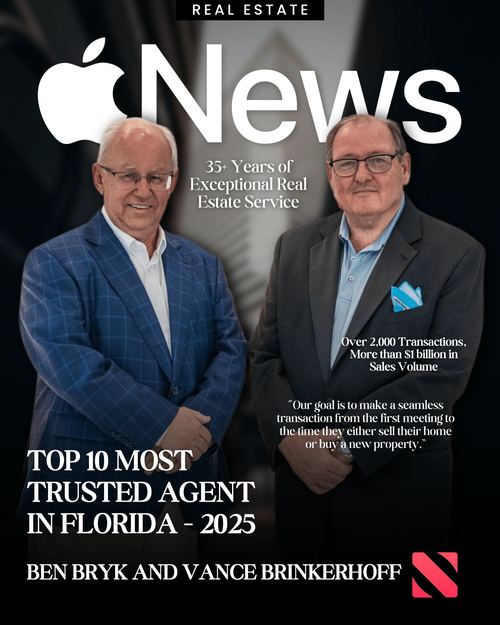
Ben Bryk and Vance Brinkerhoff have spent 35 years working with high-net-worth clients making precisely this transition. Their financial concierge desk connects every relocating client with the domicile counsel, multi-state estate planning attorneys, and private banking professionals who have navigated the New York audit process at the highest levels of taxpayer complexity.
With more than 2,000 closed transactions and over $1.2 billion in verified sales volume — confirmed by RealTrends, which ranks the team in the top 1.5% of all active realtors nationally — they bring to every client relationship a depth of market expertise and professional network that no other team in this region can match. Apple News recognized them among Florida's Top 10 Most Trusted Realtors in 2025.

For buyers whose financial decisions operate at institutional speed, the Ben Bryk and Vance Brinkerhoff mobile application delivers real-time access to Vero Beach's luxury market. Available on the Apple App Store, it is the only proprietary realtor application within a 100-mile radius — providing instant listing notifications, comprehensive property data, and the around-the-clock responsiveness that high-net-worth clients expect.
Their listings sell 40% faster than the market average. In a market with genuine scarcity at the luxury tier, speed and access are not conveniences. They are competitive advantages.
Financial concierge services · Domicile counsel introductions · Multi-state estate planning · Luxury estate representation
Coldwell Banker Global Luxury · Paradise · 35 years · $1.2B+ sold · Top 1.5% nationally · RealTrends verified
Legal Disclaimer: This article is editorial and informational in nature and does not constitute legal or tax advice. The discussion of New York State residency audit procedures, data sources, and questionnaire content is general and illustrative; actual audit processes vary by case and are subject to change. High-net-worth individuals considering a change of domicile should engage qualified legal and tax counsel before taking action. Ben Bryk and Vance Brinkerhoff are licensed Florida real estate professionals affiliated with Coldwell Banker Paradise and do not provide legal or tax advice. RealTrends national ranking and sales volume independently verified. Apple News "Top 10 Most Trusted Realtors in Florida" designation 2025.
SEO Keywords: New York residency audit Florida · why New York audits high earners moving Florida · New York domicile audit defense · New York residency questionnaire · audit trail New York to Florida · high net worth relocation audit risk · New York tax enforcement Florida departure · Vero Beach luxury real estate · wealth migration Vero Beach Florida · Indian River County luxury homes · Treasure Coast real estate · 62.7 percent cash buyers Vero Beach · Coldwell Banker Global Luxury Vero Beach · Ben Bryk Vance Brinkerhoff · financial concierge real estate Vero Beach · Florida domicile defense · New York statutory residency audit · E-ZPass audit New York · cell phone location data tax audit

Lead Real Estate Agent
Buying a home is a very emotional experience, especially for those who have not done it very often. My experience in sales can help guide buyers with an analytical approach.
Find Your Dream Home
Get assistance in determining current property value, crafting a competitive offer, writing and negotiating a contract, and much more. Contact us today.