

Ask ten homeowners what Amendment 3 does, and most will describe the same benefit: a bigger exemption, a smaller bill. Ask which kind of Florida property they mean, and the answer usually stops there. It matters more than most coverage has suggested. HJR 1-F, the constitutional amendment that passed the Florida Legislature on June 2 and now awaits a November vote, does not treat every property the same way. It splits into two separate tracks — one for a primary residence, one for everything else — and a buyer weighing a second home against a full relocation is, in effect, choosing which track applies to them.
The distinction is not a footnote. It determines whether a purchase qualifies for an expanded exemption that could eliminate the non-school portion of a tax bill entirely, or for a narrower protection that merely slows how fast an assessment can climb. Both tracks run through the same amendment. Neither crosses into the other.
I · The Date That Fixed The StructureWhy June 2 is the date that matters
For most of 2026, the property tax debate in Tallahassee ran through competing proposals with different designs. Some phased elimination over a decade. Some applied only to homesteaded property and left the rest of the market untouched. None had reached a floor vote that held. On June 2, that ambiguity ended. The Florida House passed CS/HJR 1-F by a vote of 75 to 26, and the Senate followed the same day, 30 to 9, consolidating the debate into a single measure with a specific, bifurcated design: one exemption schedule for homesteaded property, one assessment cap for everything else. Before that date, a buyer weighing a second home against a full relocation was pricing an unknown. After it, the structure is fixed, even though the outcome in November is not.
II · What Each Track Actually ContainsThe mechanics, without the shorthand
Track one belongs to a primary residence. Florida’s standing homestead exemption already removes $50,000 of assessed value from most of a property tax bill, and the 1992 Save Our Homes amendment caps that property’s annual assessment increase at three percent or inflation, whichever is lower, regardless of what the surrounding market does. If Amendment 3 passes, the exemption rises to $150,000 in 2027 and $250,000 in 2028, a threshold the House’s own staff analysis estimates would eliminate non-school property tax for roughly 60 percent of homesteaded owners. School levies are unaffected either way.
Track two belongs to everything else — a second home, a rental, a commercial property. None of it receives the new exemption, at any threshold, under any version of the amendment now on the ballot. What it receives instead is a lower ceiling on how fast its assessment can rise: down from ten percent annually today to five percent if the amendment passes. It is a real benefit, and a materially different one. A second home in a fast-appreciating market is protected from a sharper spike in taxable value. Its tax bill is never eliminated.
III · The Decision This Actually InformsWhat a buyer should model before closing
None of this changes whether a property is worth buying. It changes what a buyer should model before closing. A household treating a barrier island purchase as a second home, with a primary residence remaining in the Northeast, is pricing Track Two: a capped but permanent tax bill. A household relocating fully, and establishing Florida residency by December 31, 2026, is pricing Track One, with a meaningfully larger potential exemption if voters approve it in November. Neither choice is right in the abstract. It depends on where a family intends to spend the majority of the year, and that is a legal and tax question as much as a lifestyle one.
Vero Premier Properties, the Signature Division of Coldwell Banker Global Luxury, exists to walk buyers through exactly this kind of structural question before it becomes an expensive surprise after closing. The firm ranks among RealTrends’ top 1.5 percent of agents nationally, was named to Apple News’s Top 10 Most Trusted Realtors in Florida for 2025, and holds the Cleveland Clinic Preferred Physician Realtors designation, exclusive to Indian River County. It is a member of the International Luxury Alliance, spanning sixty markets, and its founding principals have closed more than $1.2 billion across 2,000-plus career transactions.
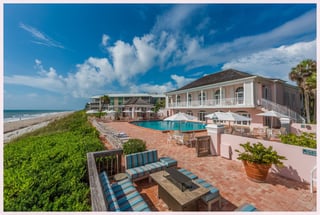
Deep-water access, oceanfront amenities, and championship golf — available on either track.


Two properties can sit on the same street and answer to two different tax outcomes, and the deed is what decides which one applies. Amendment 3 rewards a primary residence more than it protects a second one. That is a design choice, not an oversight, and it belongs in the math before the offer, not after the closing. Know which track you are on before you close.
Answer DeskFrequently asked questions
Does Amendment 3 apply to second homes and rental properties?
Not the expanded exemption. Second homes, rentals, and commercial property are non-homestead property, and receive no new exemption under Amendment 3 (HJR 1-F). They would instead see the annual assessment cap fall from 10 percent to 5 percent if the amendment passes.
What is the difference between the homestead exemption and the non-homestead assessment cap?
The homestead exemption removes a fixed dollar amount from a primary residence’s taxable value: $50,000 today, rising to $150,000 in 2027 and $250,000 in 2028 if Amendment 3 passes. The non-homestead assessment cap instead limits how much a property’s taxable value can increase in a single year: currently 10 percent, falling to 5 percent under the same pending amendment. One reduces the bill; the other slows its growth.
Should I make a Florida property my primary residence to qualify for the larger exemption?
Only the expanded homestead exemption is tied to primary-residence status, and Amendment 3 is not yet law. The decision should turn on where a household actually intends to live for the majority of the year, confirmed with qualified legal and tax counsel, not on the tax benefit alone.
Does the December 31, 2026 deadline matter if Amendment 3 does not pass?
The deadline only carries a cost if the amendment passes. Establishing Florida residency by December 31, 2026 positions a buyer for the expanded exemption on the standard schedule if voters approve it. If the amendment fails, nothing is lost by having established residency early.

Search the barrier island from anywhere
Collaborate directly with our team and start an instant home search. Editors’ Choice on the Apple App Store, 4.9 stars — the only luxury real estate app within roughly 100 miles of Vero Beach.

The Signature Division of Coldwell Banker Global Luxury, specializing in luxury barrier-island real estate across Sea Oaks, Grand Harbor, John’s Island, Orchid Island, and Windsor. Past president of the Realtors Association of Indian River County and the Vero Beach Exchange Club.
FloridaEastCoastLuxuryHomes.com