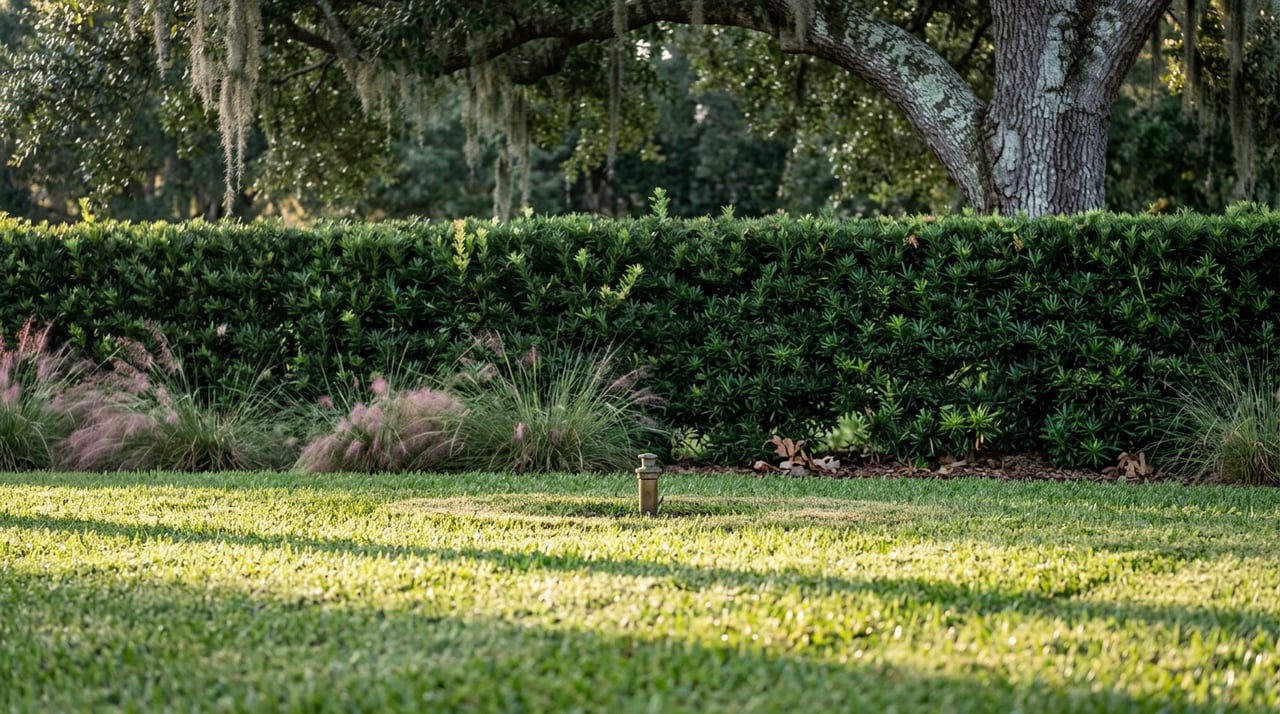
John's Island's Grass Was Drinking the Same Water You Do. Not Anymore.
August 27, 2026
August 27, 2026
On a Wednesday this past April, a small crowd gathered around one of four steel valve assemblies buried near John's Island's irrigation ponds. Property Owners Association President David Fisher and Vero Beach Mayor John Cotugno cut a blue ribbon. County Commissioner Joe Earman was there, along with city council members Aaron Vos, John Carroll and Taylor Dingle, plus representatives from the Indian River Land Trust, the St. Johns River Water Management District, the John's Island Water Management Board and John's Island Club.
It looked, from a distance, like a routine infrastructure photo op. It wasn't. The valve those two men opened marked the end of a decade-long problem that most residents never knew they had: John's Island had been irrigating 1,650 acres of lawns, common areas and golf courses with water pulled from the same aquifer that supplies drinking water to the island, mainland Vero Beach and the rest of Indian River County.
That's the part worth sitting with. Every time a sprinkler head clicked on along a fairway or a front lawn, it was drawing from the same underground source as the tap in your kitchen.
For years, the community had leaned on a stopgap: reuse water piped in from the city through an aging line. It kept the grass green, but it was still high in nitrogen, which made it a liability rather than a solution. Nitrogen runoff is exactly what feeds the harmful algae blooms that have plagued the Indian River Lagoon, and Vero Beach is one of dozens of Florida cities, counties and agencies legally required under the state's Indian River Lagoon Basin Management Action Plan to cut the amount of nitrogen and phosphorus reaching the water. Irrigating a golf community with nitrogen-heavy reuse water while trying to meet a lagoon-cleanup mandate was never a stable arrangement. It was a problem waiting for someone to actually fix it.
That someone turned out to be Rob Bolton, the city's Water and Sewer Director, who designed a $13.5 million pipeline capable of delivering three million gallons of purified canal water to John's Island every day. The Property Owners Association would use 2.8 million gallons daily for lawns and common areas. The Club, a legally separate entity from the POA, would draw 200,000 gallons daily to irrigate its two island golf courses.
What makes this a genuinely local story, and not a generic city press release, is how long it took to get here. Fisher didn't inherit an easy win. His predecessor, Jim Poole, spent his tenure trying to untangle the water problem, and before Poole it was Lou Hoynes who carried the effort forward, though health problems kept him from attending the ribbon cutting he'd spent years working toward. One local paper summed up what those two presidents were up against as trying to solve the Rubik's Cube of a clean, reliable water supply.
Solving it required more than an engineering fix. It meant coordinating funding and approval across the POA, the Club, the city, the St. Johns River Water Management District and the Florida Department of Environmental Protection, four organizations with different priorities and different checkbooks, all needing to agree on how to split a pipeline that no single one of them could justify building alone.
County Commissioner Laura Moss, who represents most of the barrier island, framed the real payoff at the ceremony:
"It's also important because it can become a template for other communities to do similar projects."
The reason this project got built now, after a decade of stalling, comes down to numbers that finally lined up for everyone at the table.
For a community that spent years unable to solve its own irrigation problem in isolation, the fix arrived only once the city needed John's Island's cooperation on lagoon compliance as much as John's Island needed a way off the aquifer. Neither side could get there alone. That's why it took three POA presidents and a coalition of four agencies to sign off on four valve assemblies.
If you live in John's Island, you're unlikely to notice a single blade of grass looking different. That's the point. The upgrade is entirely underground: four valve assemblies feeding existing irrigation holding ponds, no new construction scars, no disruption to the golf calendar. What changed is where the water in those ponds comes from and what it's no longer doing to the aquifer beneath your home.
The community's 1,650 acres of turf and common areas are now running on purified canal water rather than wells drawing from the region's drinking water supply. The two island golf courses maintained by John's Island Club are on the same new system. If you've ever wondered how the fairways stayed lush through a dry spring without visible watering restrictions, the answer is now sitting in a pipeline that didn't exist a year ago.
The city, meanwhile, gets a small ongoing revenue stream from selling that purified water, plus a decade of breathing room on a lagoon-cleanup mandate that applies to dozens of municipalities well beyond Vero Beach's borders. That's likely why representatives from the Land Trust and the water management district showed up to watch a ribbon get cut. A model that works here, splitting cost and water between a city and a private club community, is exactly the kind of arrangement other Treasure Coast towns facing the same BMAP deadlines will be studying next.
None of this shows up on a property listing or a landscaping invoice. It's the kind of civic engineering that only matters to the people who already call a place home, which is precisely why it's worth knowing if you're one of them.
If you're weighing what a home in a community like this is actually worth, infrastructure decisions like this one are part of the answer, not just the view or the golf course access. Vero Premier Properties has spent years tracking the details that shape John's Island's long-term value. Reach out for a private conversation, or start with a free, no-obligation home valuation to see where your property stands today.

Lead Real Estate Agent
Buying a home is a very emotional experience, especially for those who have not done it very often. My experience in sales can help guide buyers with an analytical approach.
Find Your Dream Home
Get assistance in determining current property value, crafting a competitive offer, writing and negotiating a contract, and much more. Contact us today.