Estate Planning Across State Lines: What Changes When You Move to Florida and Why It Matters Now
Ben Bryk May 26, 2026
Ben Bryk May 26, 2026
A Florida address changes more than your tax bill. It changes the legal foundation of your estate — every document that governs how your wealth transfers, who controls your affairs if you cannot, and how your most significant asset is protected under law. For high-net-worth households relocating to Vero Beach, updating the plan is not optional and it is not a formality. It is among the most consequential legal tasks of the transition.
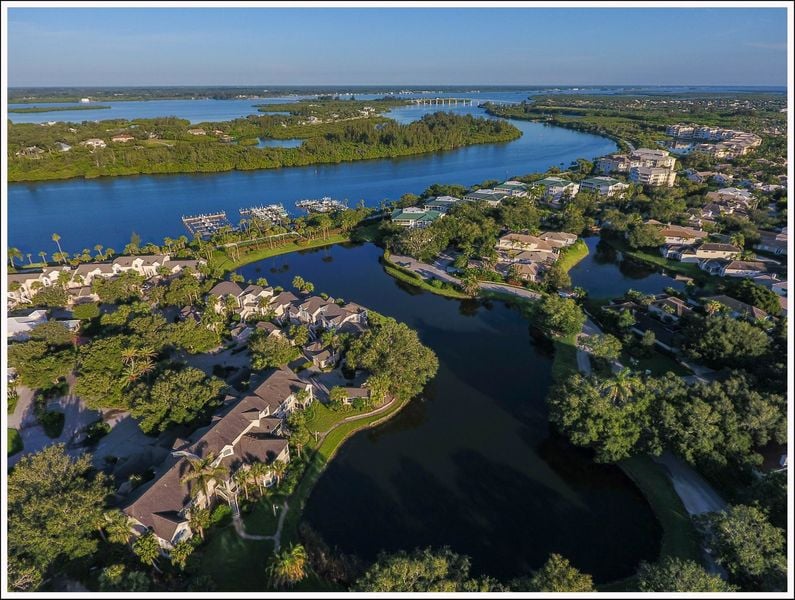
The Indian River Lagoon corridor, Vero Beach — where high-net-worth households from New York, New Jersey, Connecticut, and Boston are not merely changing their address but restructuring the legal architecture of their financial lives. · © Ben Bryk & Vance Brinkerhoff
The conversation about moving to Florida almost always begins with taxes. It is the right place to start — the financial case for a high-net-worth household departing New York or New Jersey is significant, well-documented, and increasingly urgent. But the conversation that matters most, and the one that is most frequently deferred, is not about what Florida does not tax. It is about what Florida law governs differently once you arrive — and what that means for the legal documents that determine how your wealth is managed, transferred, and protected for the rest of your life.
Florida is not simply a lower-tax version of New York. It is a distinct legal jurisdiction with its own probate code, its own trust law, its own rules governing spousal rights in property, its own constitutional homestead provisions, and its own requirements for the documents that establish who speaks for you if you cannot speak for yourself. A will drafted by a Manhattan estate attorney under New York law does not become invalid the moment you cross the state line — but it may no longer operate as intended. And in a state where the homestead exemption can shield a primary residence worth any amount from creditor claims, failing to understand Florida's rules is not merely an administrative oversight. It is a strategic failure.
Every document below should be reviewed by Florida-qualified estate counsel within 90 days of establishing Florida domicile. Several require active updating; others require Florida-specific additions that northeastern documents typically omit entirely.
Status: Requires review and likely revision. A will validly executed in New York, New Jersey, Connecticut, or Massachusetts is generally recognized in Florida. But the operative law governing how it is interpreted, what spousal elective share rights apply, and how the Florida homestead interacts with testamentary provisions may produce results entirely different from what was intended. A New York will leaving the primary residence outright to children may conflict with Florida's constitutional homestead restrictions on devise — particularly when a surviving spouse is involved. Florida estate counsel must review every will for compatibility with Florida's probate code before it is relied upon.
Status: Requires Florida amendment and asset re-titling. Most sophisticated high-net-worth households relocating from the Northeast maintain revocable living trusts as the foundation of their estate plans — and for good reason. But the trust must be reviewed for Florida law compatibility, amended as necessary to reflect the new domicile, and — critically — the Florida real property must be properly transferred into the trust. An unfunded trust is not a trust for practical purposes. Florida real estate titled outside the trust goes through probate. The amendment and re-titling process should occur simultaneously with the property closing.
Status: Should be replaced with a Florida-compliant instrument. Florida's Durable Power of Attorney Act, substantially revised in 2011, imposes specific formal requirements — including witness and notarization standards — that differ from northeastern requirements. While a validly executed out-of-state power of attorney is not automatically void in Florida, financial institutions and healthcare providers in this state routinely decline to honor out-of-state instruments that do not conform to Florida's statutory requirements. A Florida-specific durable power of attorney, executed by Florida-qualified counsel, eliminates this risk entirely.
Status: Replace with Florida-specific documents immediately. Florida has its own statutory forms for the designation of healthcare surrogate and the advance directive — what most states call a living will. While Florida will generally honor out-of-state healthcare directives that comply with Florida law, the practical reality is that Florida healthcare providers are most comfortable with documents that conform to Florida's statutory language. Given the stakes involved — these documents govern decisions made in medical emergencies — there is no justification for relying on documents drafted under another state's laws. Florida-specific healthcare documents should be executed at the same time as the domicile change.
Status: Review all retirement accounts, life insurance, and financial accounts. Beneficiary designations on IRAs, 401(k)s, life insurance policies, and financial accounts pass outside the probate estate and are not governed by the will or trust. They must be reviewed — not assumed — to ensure they remain consistent with the current estate plan under Florida law. The interaction between beneficiary designations and the Florida elective share for surviving spouses requires specific attention for households with significant retirement assets.
Status: Specialized review required — particularly for state income tax implications. Irrevocable trusts established under New York, New Jersey, or Connecticut law may be subject to those states' income taxes on trust income even after the grantor has changed domicile to Florida — depending on the trustee's location, the beneficiaries' locations, and the sourcing of trust income. For households with significant irrevocable trust structures, including GRATs, SLATs, QPRTs, or dynasty trusts, a comprehensive multi-state trust review with qualified counsel is essential before and after the move.
Grand Harbor Beach Club, Vero Beach. The Florida homestead provides unlimited creditor protection on a primary residence — one of the most powerful asset protection provisions in American law, and one of the most compelling reasons high-net-worth households establish Florida domicile with a genuine primary home. · © Ben Bryk & Vance Brinkerhoff
1. Creditor Protection: Florida's constitutional homestead exemption protects a primary residence from forced sale by creditors — with no dollar cap. A $10 million oceanfront estate in Vero Beach, properly designated as homestead, is entirely shielded from judgment creditors (with limited exceptions for mortgage lenders, tax authorities, and mechanics' liens). For entrepreneurs, executives, and professionals with any exposure to personal liability, this protection alone is among the most compelling legal arguments for establishing Florida domicile.
2. Property Tax Reduction: Florida homestead designation provides a property tax exemption of up to $50,000 on assessed value for primary residences, and — more significantly — the Save Our Homes cap, which limits annual increases in assessed value to 3% or the rate of inflation, whichever is lower. For a Vero Beach estate acquired at today's values, the long-term tax benefit of the Save Our Homes cap compounds significantly over time.
3. Devise Restrictions: Florida's homestead law restricts how a primary residence may be left at death when a surviving spouse or minor children exist. A testator with a surviving spouse cannot devise the homestead to anyone other than the spouse — regardless of what the will says. For households with complex blended family structures, children from prior relationships, or estate plans that direct the primary residence to a trust, these restrictions require careful planning before the move, not discovery in probate.
A Vero Beach waterfront golf community. Florida imposes no state estate tax — a distinction that, for estates at the upper end of the high-net-worth spectrum, represents a material planning advantage over every northeastern state that maintains its own estate tax regime. · © Ben Bryk & Vance Brinkerhoff
Florida has no state estate tax. New York imposes an estate tax with a top rate of 16% on estates above the exemption threshold — and New York's so-called "cliff" provision means that estates modestly above the exemption threshold can face effective marginal rates significantly in excess of the stated top rate. New Jersey, Connecticut, and Massachusetts each maintain their own estate tax regimes with varying exemptions and rates.
For a high-net-worth household with an estate of $10 million or more, establishing Florida domicile eliminates this state-level estate tax entirely. The federal estate tax continues to apply, but state-level liability — which in New York can represent hundreds of thousands of dollars on a moderately large estate — goes to zero at the moment Florida becomes the legal domicile.
Estate tax is assessed based on domicile at the time of death, not at the time of an estate plan's execution. A household that changes domicile to Florida, establishes a primary residence here, and maintains that domicile through the date of death owes no Florida estate tax and no New York estate tax — regardless of where the original estate plan was drafted.
But a household that claims Florida domicile for income tax purposes while maintaining New York as the genuine center of life faces the possibility that New York — which has clear financial incentive to assert domicile — will claim the decedent as a New York domiciliary at death and assess estate tax accordingly. The domicile audit does not end with income tax. It continues through the estate administration. This is why the quality of the Florida domicile established during lifetime is not merely a tax question — it is an estate planning question with potentially significant financial consequences.
The federal estate tax exemption — currently at historically elevated levels following the Tax Cuts and Jobs Act — is scheduled to sunset at the end of 2025, reverting to approximately half its current level absent Congressional action. For high-net-worth households whose estates currently fall below the federal exemption but would exceed a reduced threshold, the planning window is not merely important. It is closing. Florida's combination of no state estate tax, unlimited homestead creditor protection, and a trust law that accommodates sophisticated asset protection structures makes it the optimal base jurisdiction for the restructuring that current federal law changes may demand.
The households moving to Vero Beach from New York, New Jersey, Connecticut, and Boston are arriving at a moment when the convergence of state tax departure benefits and federal estate planning urgency makes the transition more financially significant than at any previous point in recent memory. The 62.7% cash transaction rate in this market reflects buyers who have resolved the financial complexity — but the estate planning dimension of the transition is one that even well-advised households frequently underestimate until they are in the middle of it.
High-net-worth households relocating from the northeastern estate tax corridor are not simply changing their address — they are restructuring the legal and financial architecture of their estates. Vero Beach's 62.7% cash buyer concentration reflects principals who have arrived with capital, conviction, and the professional support structure to complete this transition correctly across every dimension simultaneously.
"The estate planning review is not the paperwork that follows the move. It is part of the move. For a household of any genuine complexity, the documents that govern how wealth transfers should be in a Florida attorney's hands before the closing."
Ben Bryk & Vance Brinkerhoff · Coldwell Banker Global Luxury · ParadiseBen Bryk and Vance Brinkerhoff have spent 35 years working with high-net-worth households making precisely this transition. The financial concierge desk they operate connects every relocating client with Florida-qualified estate planning attorneys experienced in multi-state trust and probate matters, domicile counsel, private banking relationships, and CPAs with northeastern departure expertise.
For clients whose estate plans require immediate attention — and for a household of genuine complexity, they all do — the concierge desk ensures that the legal infrastructure of the transition is in place before, during, and after the property closing. Not assembled reactively months later.
For buyers whose decisions operate on institutional timelines, the Ben Bryk and Vance Brinkerhoff mobile application — available on the Apple App Store and the only proprietary realtor app within a 100-mile radius — provides real-time listing access, instant notifications, and the around-the-clock responsiveness that high-net-worth clients expect.
Their listings sell 40% faster than the market average. In a market with genuine scarcity at the luxury tier, that speed is not a convenience. It is a competitive advantage that determines outcomes.
Estate planning introductions · Domicile counsel · Financial concierge services · Luxury estate representation
Coldwell Banker Global Luxury · Paradise · 35 years · $1.2B+ sold · Top 1.5% nationally · RealTrends verified
Legal Disclaimer: This article is editorial and informational in nature and does not constitute legal, tax, or estate planning advice. All discussion of Florida law, estate tax, homestead provisions, trust law, and estate planning documents is general and illustrative. Laws change, and individual circumstances vary significantly. High-net-worth individuals considering a change of domicile or any estate planning action should engage qualified legal counsel licensed in Florida before taking action. Ben Bryk and Vance Brinkerhoff are licensed Florida real estate professionals affiliated with Coldwell Banker Paradise and do not provide legal, tax, or estate planning advice. RealTrends national ranking and sales volume are independently verified. Apple News "Top 10 Most Trusted Realtors in Florida" designation 2025.

Lead Real Estate Agent
Buying a home is a very emotional experience, especially for those who have not done it very often. My experience in sales can help guide buyers with an analytical approach.
Find Your Dream Home
Get assistance in determining current property value, crafting a competitive offer, writing and negotiating a contract, and much more. Contact us today.